



Even if you’re meeting deadlines, managing a team, or making it to the kids’ soccer games, you know the truth—something is slipping.
You’ve been running at full speed for so long that exhaustion feels normal. You tell yourself you’re “just tired” or “in a rough patch.” But deep down, you know you’re not just busy—you’re burning out.
And the idea of stepping into an intensive outpatient program feels like adding one more impossible thing to an already overloaded schedule. You wonder, “Can I really juggle treatment, my job, and my family?”
But here’s the harder question: Can your job and your family handle you not getting help?
The Myth of “Holding It All Together”
On the outside, you look steady. You still show up to meetings, pay bills on time, and remember to sign the field trip permission slip. To the people around you, that might be proof you’re fine. But you know the truth—your “togetherness” is held up by caffeine, alcohol, late nights, or whatever helps you push through.
High-functioning doesn’t mean unbreakable. It just means the cracks are harder for others to see. And when those cracks widen, they rarely do so quietly.
One client put it this way:
“I thought no one noticed how much I was drinking because I never missed work. Then my boss told me I didn’t seem like myself anymore—said my spark was gone. That’s when I realized I wasn’t fooling anyone.”
Why an IOP Fits Into Real Life
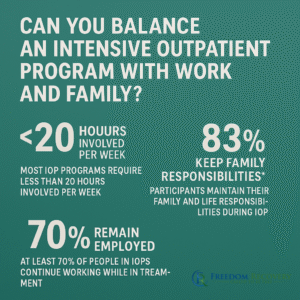
The biggest misconception about getting help is that you have to disappear from your life to do it. In reality, an intensive outpatient program (IOP) is designed for people who can’t—or don’t want to—step completely away from work or family.
You attend therapy sessions multiple times a week, often in the mornings or evenings, depending on the program. You return home each night. You keep your job. You’re there for bedtime stories and work deadlines. But you also have structured support and a team looking out for your recovery.
It’s not about blowing up your life to save it—it’s about weaving help into the life you already have so the whole thing doesn’t fall apart.
When Not Getting Help Costs More Than Time
The cost of untreated addiction isn’t just financial—it’s emotional and relational. You may notice:
- Deadlines get harder to meet.
- Patience with your kids wears thin.
- Your partner starts asking why you’re so irritable.
- You avoid social plans that could expose your coping habits.
These changes don’t usually happen overnight. They creep in slowly, until “just stressed” becomes the default explanation for everything.
One IOP graduate told us, “I was so worried my team would resent me for taking time off for treatment. But what they really noticed was when I started missing things—meetings, deadlines, the little details I used to catch. That was the bigger problem.”
Your Family Would Rather Have You Tired From Therapy Than Gone
The people who love you don’t need perfection—they need you present. They’d rather shuffle the carpool schedule or eat more takeout for a month than watch you fade away piece by piece.
In a place like Columbus, where many families depend on each other for daily life, short-term inconvenience is a small trade for long-term stability. You might be surprised at how willing people are to adjust if it means keeping you well.
Your kids don’t need every lunch to be packed perfectly. They need you calm enough to sit with them while they tell you about their day. Your partner doesn’t need you to handle every household task. They need you healthy enough to laugh at an inside joke without the shadow of exhaustion in your eyes.
Columbus Has Options That Work With Your Life
The good news is, you don’t have to choose between treatment and your responsibilities. Programs like ours in Columbus, Ohio, are built to work with your schedule. Whether you need early morning sessions before work or evening options after dinner, IOP is designed to fit into a life that doesn’t stop.
If Columbus isn’t your most convenient location, you can explore our programs in Dayton and Galion. No matter where you go, the structure is built to help you get better without forcing you to step away from your life completely.
Choosing IOP Is Choosing to Stay Present
Treatment isn’t about stepping away from your life—it’s about stepping back into it fully. It’s the difference between skimming through life in survival mode and being present enough to actually feel it.
Your job will survive a few hours a week without you. Your family can adjust dinner plans. But what they can’t do forever is keep functioning around the version of you that’s running on fumes.
And here’s the thing—once you make the decision, you’ll often find that the people around you are more relieved than resentful.
FAQ: Intensive Outpatient Program and Your Life
1. How many hours a week does an IOP take?
Most intensive outpatient programs require 9–12 hours a week, spread over 3–4 days. Many programs, including ours, offer flexible morning or evening options to fit work schedules.
2. Will my employer have to know?
Not necessarily. Some people choose to be open with their employer, especially if they need schedule adjustments. In many cases, you can arrange your sessions outside of work hours. If you do disclose, you may be protected under laws like FMLA (Family and Medical Leave Act).
3. Can I still take care of my kids during IOP?
Yes. Most parents in IOP continue their parenting responsibilities while attending sessions. It may require help from a partner, family member, or trusted friend, but the flexibility of IOP makes it possible to keep showing up for your children.
4. How long does an IOP last?
The length varies, but many last 8–12 weeks. Your exact timeline will depend on your needs and progress.
5. Is IOP only for people with severe addiction?
No. IOP is for anyone who needs structured support but doesn’t require 24/7 supervision. It’s especially helpful for high-functioning individuals who want to address concerns before they escalate.
Ready to see if IOP can work for you—and for them?
Call (888) 643-7567 or visit our intensive outpatient program services in Columbus, Ohio to learn more.