



You’ve had the conversations. You’ve set boundaries. You’ve stayed up at night wondering what you missed. And still, your 20-year-old insists they’re fine.
From a clinical perspective, this moment—where concern meets denial—is more common than most parents realize. And it doesn’t mean you’ve failed. It means you’re standing at a very difficult crossroads.
Early support can still work, even if they’re not asking for it yet. You can explore options like an addiction treatment program without forcing a breaking point.
Denial Isn’t Defiance—It’s Often Protection
Many young adults don’t see their substance use the way others do. Not because they’re trying to be difficult—but because acknowledging a problem can feel overwhelming.
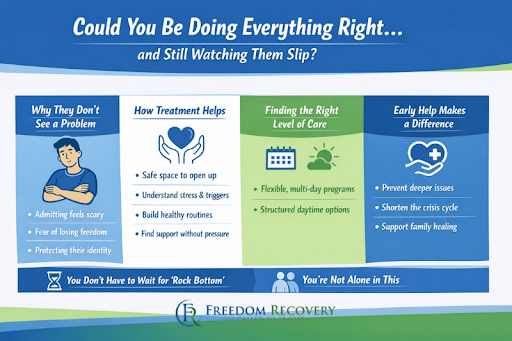
At 20, identity is still forming. Admitting “I need help” can feel like giving something up—freedom, control, or even who they think they are.
So instead, they minimize.
They compare.
They deflect.
This isn’t uncommon. And it’s not the end of the story.
What Treatment Actually Offers (Even If They’re Unsure)
Treatment doesn’t begin with labels or ultimatums. It begins with structure, safety, and space to be honest—often for the first time.
Programs that meet young adults where they are can help them:
- Understand patterns without shame
- Explore stress, anxiety, or underlying struggles
- Build routines that don’t revolve around substances
- Experience connection without pressure
Sometimes the shift is subtle. A single moment of clarity. A conversation that lands differently.
That’s often how change begins.
Not Every Program Feels the Same—and That Matters
One of the biggest misconceptions is that treatment is “all or nothing.”
In reality, there are different levels of care depending on what someone can handle right now.
Some options provide structured daytime care with more support and supervision. Others offer multi-day weekly treatment that allows them to stay connected to daily life.
If you’ve come across the question of IOP vs PHP for addiction, what you’re really asking is:
“How much support does my child need—and what will they actually accept?”
That’s a meaningful question. And it’s okay not to have the answer yet.
You Don’t Have to Wait for Them to Hit Bottom
There’s a quiet myth that things have to get worse before they can get better.
Clinically, we know that’s not true.
Early intervention—even in moments of resistance—can:
- Reduce long-term risk
- Shorten the cycle of relapse
- Help families regain stability sooner
Support can begin with education, conversations, or even just understanding your options.
You’re allowed to act on concern—not just crisis.
What Helps When They Push Back
This is the part that hurts the most.
You care deeply. They don’t see it the same way.
Instead of trying to convince them, it can help to:
- Stay consistent rather than escalating
- Focus on your observations, not accusations
- Keep the door open without forcing it
You might say, “I’m here when you’re ready—but I also need to take care of what I can control.”
That balance is hard. But it protects both of you.
You’re Not Alone in This—Even If It Feels Like It
Parents often carry a quiet belief: “I should have been able to stop this.”
But addiction doesn’t happen because of one moment—or one mistake.
And helping someone doesn’t mean controlling them.
There are families right now, in places like Grove City and Upper Arlington, having the same conversations, asking the same questions, feeling the same mix of love and exhaustion. Access to care in Addiction and ongoing support in Addiction can make a difference—not just for your child, but for you as well.
There’s no perfect way to handle this. No script that guarantees change.
But there are next steps. There are options. And there is still time.
Call (888)643-7567 or visit the Addiction treatment program services in Columbus, Ohio to learn more about how support can begin—right where you are.