



It’s a quiet fear that creeps in slowly.
A missed call. A change in tone. A feeling you can’t quite explain—but you know something isn’t right.
If you’re wondering whether your child may be drinking again, you’re not alone. And more importantly, you’re not without options.
Early on, many parents find themselves searching for answers—trying to understand behaviors that don’t quite add up. If that’s where you are, it may help to explore what alcohol addiction treatment can address beneath the surface—not just the drinking itself.
It’s Not Always Obvious at First
Relapse doesn’t always look dramatic.
Sometimes it’s subtle. A shift in routine. More isolation. Irritability that wasn’t there before. You might notice they’re harder to reach—or that conversations feel shorter, more guarded.
These changes can be easy to second-guess. You may tell yourself, “Maybe I’m overreacting.”
But as a clinician, I can tell you—parents often sense something before they can prove it.
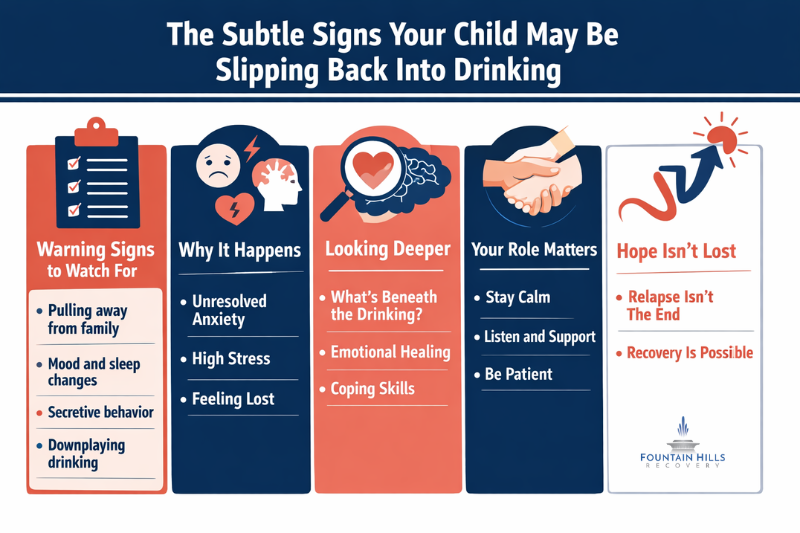
🚩 Signs You Might Be Seeing Something Real
Even if your child appears “functional,” there are patterns worth paying attention to:
- Pulling away from family or support systems
- Changes in sleep, mood, or energy
- Defensiveness around simple questions
- Old habits resurfacing (late nights, secrecy)
- Downplaying alcohol use—even if it’s something like a bottle of wine every night
None of these alone confirm a relapse. But together, they can point to something deeper that needs care—not punishment.
Why Drinking Again Happens (Even After Treatment)
This is one of the hardest parts for parents to understand.
You may think: “They already got help. Why would this happen again?”
The truth is, alcohol use is rarely just about alcohol.
Relapse often connects to:
- Unresolved anxiety or depression
- Stress they don’t know how to manage
- Shame or pressure to “be okay”
- Feeling disconnected from purpose or identity
Drinking can become a way to cope—not because they want to hurt themselves or you, but because something inside still hurts.
Treatment Isn’t Just About Stopping Drinking
Good treatment looks deeper.
It asks:
- What was alcohol doing for them?
- What pain or pressure were they carrying?
- What skills are missing right now?
Depending on their needs, this might include:
- Structured daytime care with consistent support
- Multi-day weekly treatment that allows real-life practice
- Therapy that addresses both emotional health and substance use together
This kind of approach doesn’t just remove alcohol—it replaces it with something stronger: stability, insight, and healthier ways to cope.
If you’re exploring options nearby, you can learn more about treatment in Scottsdale or treatment in Fountain Hills for accessible, supportive care.
Your Role Matters More Than You Think
Many parents carry quiet guilt.
“Did I miss something?”
“Could I have prevented this?”
But relapse is not a reflection of failed parenting.
What matters most now is how you show up:
- Staying calm, even when you’re scared
- Keeping communication open (even if it’s one-sided at times)
- Encouraging support without forcing it
Your presence—steady, caring, and nonjudgmental—can be one of the most powerful influences in their recovery.
There Is Still a Path Forward
It may not feel like it right now, but this moment doesn’t erase the progress your child has made.
Recovery is rarely a straight line. For many, it’s a series of attempts, lessons, and returns.
And each time they come back—even if it’s after slipping—they bring more awareness with them.
That matters.
If you’re feeling overwhelmed or unsure what to do next, you don’t have to navigate this alone. Call (800) 715-2004 or visit our alcohol addiction treatment services in Fountain Hills, AZ to learn how we can support both you and your child.