



I used to say treatment didn’t work.
I didn’t whisper it. I didn’t say it with confusion. I said it like a conclusion.
“I tried that.”
“It didn’t help.”
“I’m just not one of those people it works for.”
If that’s you right now, I’m not here to argue with you. I’ve been there.
Before I ever seriously explored Freedom Recovery’s treatment options, I thought I already knew what an addiction treatment program was supposed to do. I thought it was there to fix me.
That misunderstanding kept me stuck for years.
I Thought It Was Supposed to Cure Me
When I first entered care, I expected a moment.
A breakthrough session.
A dramatic realization.
A permanent shift in how I felt about alcohol.
I thought I would walk in confused and walk out cured.
When cravings didn’t disappear, when I still felt restless and irritated, I decided it hadn’t worked.
What I didn’t understand was this: treatment doesn’t erase addiction. It prepares you to live differently with it.
That’s not as glamorous as a cure.
But it’s real.
I Confused Discomfort With Failure
Treatment was uncomfortable.
Group therapy forced me to hear my own patterns out loud. Individual sessions pulled up things I had worked hard to avoid. Structured days removed the chaos I secretly depended on.
I didn’t like it.
So I labeled it ineffective.
Looking back, I see how flawed that logic was.
If you go to physical therapy after an injury, it’s uncomfortable. Muscles ache. Weak spots are exposed. You don’t call it useless because it hurts.
Growth almost always feels awkward at first.
The sanding process is loud and gritty. But that doesn’t mean nothing is happening.
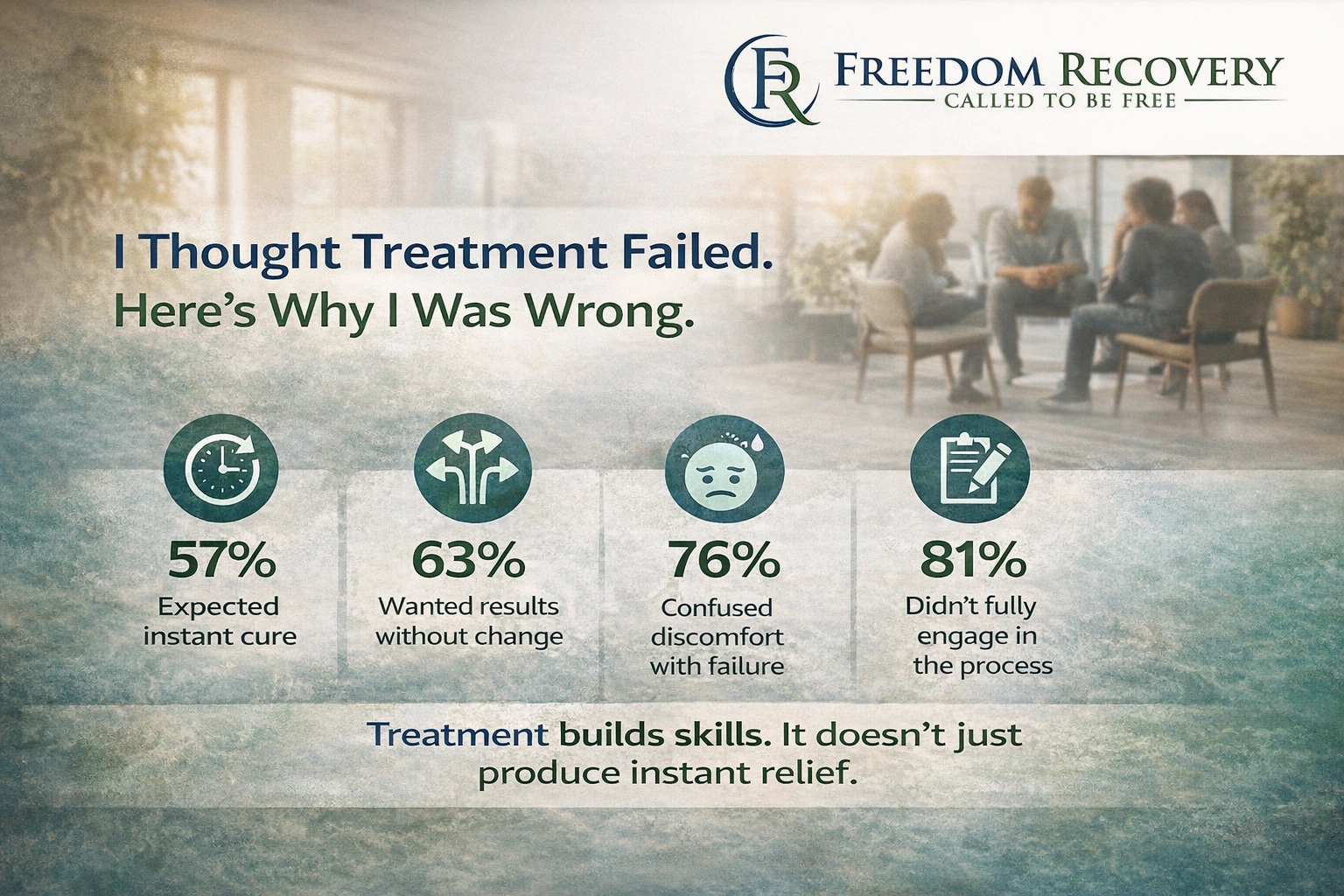
I Wanted Results Without Real Change
Here’s the part I avoided admitting.
I wanted to go through an addiction treatment program and return to my life exactly as it was — minus the consequences.
Same friends.
Same routines.
Same stress responses.
I didn’t want to change my environment. I didn’t want to examine my relationships. I didn’t want to sit with my emotions without numbing them.
I wanted relief, not transformation.
Treatment offered me tools.
I just didn’t want to use them.
That wasn’t failure on the program’s part.
That was me misunderstanding the assignment.
I Thought Sobriety Meant Becoming Someone I Didn’t Recognize
Part of my resistance was about identity.
I didn’t want to become “a recovery person.” I didn’t want slogans or personality shifts or a new label attached to my name.
When I started feeling calmer and less reactive, it actually scared me. I thought I was losing my edge.
What I was losing was chaos.
And I had confused chaos with personality.
That’s an easy mistake to make when substances have been woven into your life for years.
The Second Time, I Showed Up Differently
When I returned to structured care, I wasn’t enthusiastic.
I was skeptical. Guarded. Still carrying the belief that it probably wouldn’t work.
But I did one thing differently.
I listened.
I admitted where I had avoided responsibility.
I acknowledged that I hadn’t actually applied what I learned the first time.
I stopped pretending I was above the process.
That shift mattered more than any lecture.
For people in Dayton, Ohio, access to compassionate help in Addiction means you don’t have to pretend you’re convinced before walking through the door. Skepticism is allowed.
You just have to be willing.
Treatment Didn’t Fix Me — It Trained Me
This is the metaphor that finally clicked for me.
I thought treatment was a repair shop.
It’s more like training camp.
You don’t walk in broken and walk out flawless. You learn new movements. You strengthen weak areas. You practice different responses.
An addiction treatment program didn’t remove cravings from my brain.
It taught me how to recognize them without obeying them.
It didn’t erase my triggers.
It helped me understand them.
That difference is subtle.
But it’s powerful.
I Expected Motivation to Do the Heavy Lifting
Another misunderstanding?
I thought if treatment worked, I’d feel permanently motivated.
But motivation is unreliable. It rises and falls.
What treatment gave me wasn’t constant inspiration. It gave me structure.
It gave me:
- Accountability
- Coping strategies
- Boundaries
- A different daily rhythm
Those things carry you when motivation disappears.
And motivation always disappears at some point.
I Was Measuring the Wrong Things
I measured success by how easy it felt.
If cravings were loud, I thought I was failing.
If I felt emotional, I thought it wasn’t working.
If I struggled socially without drinking, I thought sobriety wasn’t for me.
I wasn’t measuring consistency.
I wasn’t measuring progress in my reactions.
I wasn’t measuring how many arguments I avoided, how many mornings I woke up clear-headed, how many impulsive decisions I didn’t make.
Those quiet shifts didn’t feel dramatic.
But they were everything.
Success Stories Aren’t Cinematic
When people talk about recovery success, they often picture someone glowing, transformed, unrecognizable.
That wasn’t my story.
My story looked like:
- Relapsing and coming back
- Apologizing more than once
- Sitting through uncomfortable emotions
- Choosing not to text someone I shouldn’t
- Going to bed early when I wanted to escape
In Grove City, Ohio, there are people seeking support in Addiction who are walking that same steady path.
No fireworks.
Just forward motion.
Recovery doesn’t always look impressive.
It looks consistent.
Treatment Isn’t a Personality Overhaul
I used to think if treatment worked, I would come out fundamentally different.
Calmer. Kinder. Perfect.
Instead, I came out more aware.
Awareness isn’t glamorous.
It means you can’t lie to yourself as easily.
You see patterns sooner. You catch justifications faster. You notice emotional shifts before they spiral.
That awareness is uncomfortable at first.
But it’s also freedom.
Because you can’t change what you can’t see.
If You Think It Didn’t Work
Maybe you went once and hated it.
Maybe you didn’t connect with a counselor.
Maybe you felt misunderstood.
Maybe you weren’t ready.
Maybe you did the minimum and left frustrated.
That doesn’t mean you’re beyond help.
It might mean the timing was off.
Or your expectations were.
Or your participation was half-hearted, like mine was.
An addiction treatment program isn’t a magic reset.
It’s structured support that only works if you engage with it.
That doesn’t make you weak.
It makes you human.
Frequently Asked Questions
What If I Already Tried Treatment and It Didn’t Help?
It’s common to feel disappointed after a first attempt.
Sometimes it’s about fit. Sometimes it’s about readiness. Sometimes it’s about expectations. A different level of care or a more engaged approach can change the outcome.
How Do I Know If I’m Being Skeptical or Just Avoidant?
Ask yourself this: did I fully participate last time?
Did I apply what I learned outside of sessions?
Did I make environmental changes?
Honest answers to those questions often clarify things.
Is It Normal to Feel Doubtful Going Back?
Yes. Doubt is normal, especially after feeling disappointed. You don’t have to feel convinced to show up again. You just have to be open to the possibility that your first interpretation wasn’t the whole story.
What If I Relapse Again?
Relapse doesn’t erase progress. It can be information. A signal that something needs more attention. Many long-term recovery stories include setbacks. Consistency over time matters more than perfection.
How Long Before It “Feels” Like It’s Working?
Often longer than people expect. Early recovery is about stabilization, not euphoria. The noticeable shifts — better sleep, clearer thinking, steadier moods — build gradually. You may not feel different overnight. But over months, the contrast becomes undeniable.
The Real Shift
Here’s what changed everything for me.
I stopped asking, “Is this working?”
And I started asking, “Am I working it?”
That question hurt.
But it empowered me.
Because it put some control back in my hands.
Treatment didn’t fail me.
I misunderstood what it was supposed to do.
It wasn’t there to rescue me.
It was there to train me
Call (888)643-7567 or visit our addiction treatment program in in Columbus, Ohio to learn more.