



You don’t avoid help because you don’t care about your life.
You avoid it because you care about who you are.
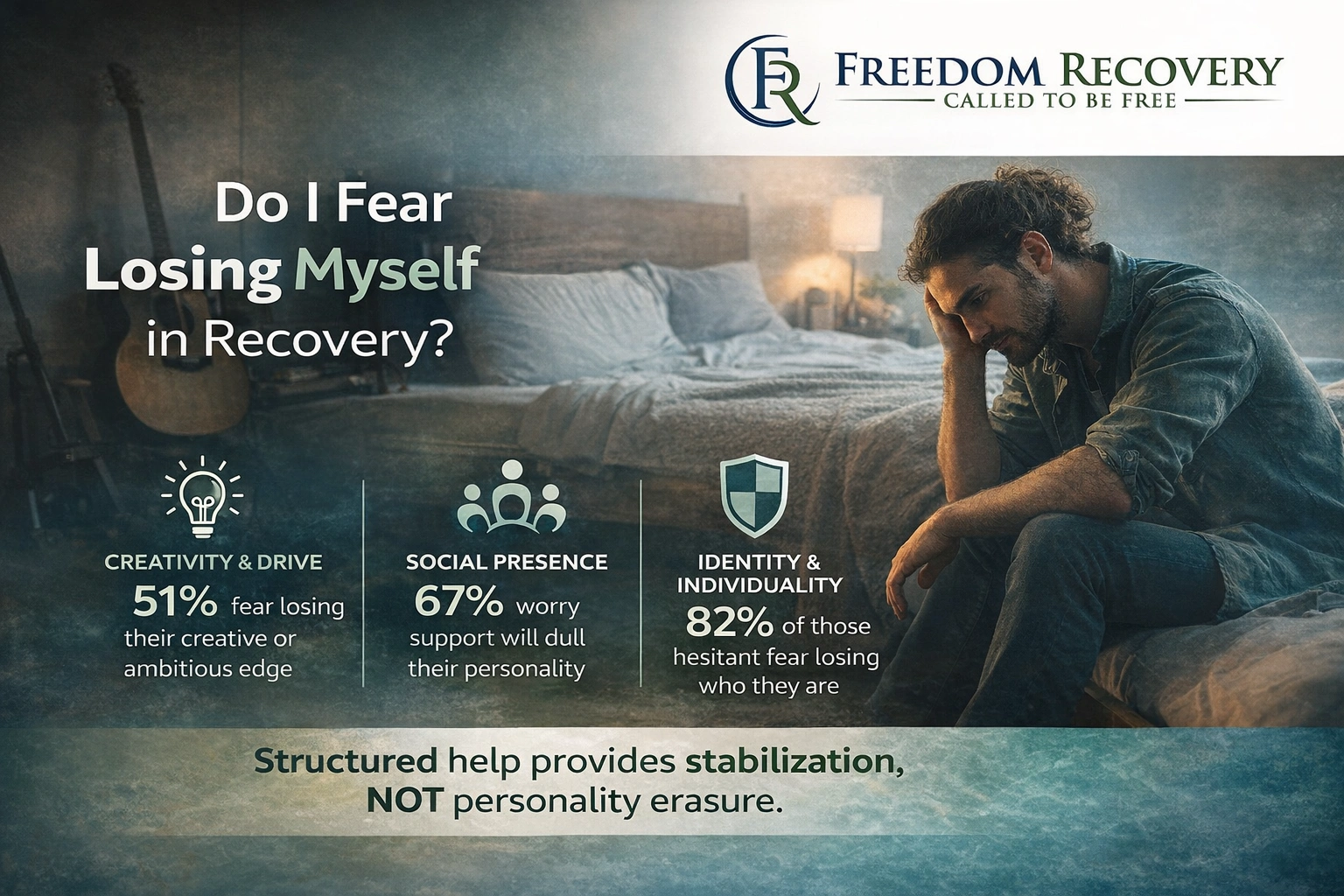
If you’re creative, emotionally intense, socially magnetic, or deeply identified with your inner world, the idea of entering structured care can feel threatening. Not because you think you’re invincible — but because you’re afraid of becoming unrecognizable.
As a clinician, I’ve sat with musicians, entrepreneurs, designers, comedians, writers, athletes — people whose identities feel vibrant and hard-earned — and I’ve heard the same quiet fear:
What if sobriety changes me?
If you’ve explored our treatment options but paused before reaching out, this hesitation may not be resistance.
It may be protection.
The Fear Isn’t About Stopping — It’s About Losing Yourself
Many identity-focused individuals don’t fear the absence of substances.
They fear the absence of intensity.
You may wonder:
- Will I still feel things deeply?
- Will I still be funny?
- Will I still be creative?
- Will I still be confident in a room?
Substances can become intertwined with personality over time. They might lower inhibition, soften social anxiety, amplify emotion, or quiet intrusive thoughts.
When something becomes part of how you access yourself, letting it go can feel like self-erasure.
That fear deserves respect.
When Substances Feel Like Part of the Persona
In certain circles, drinking or using isn’t just personal — it’s cultural.
Late nights fuel creative brainstorming. Social events revolve around alcohol. Performance anxiety is masked by something that takes the edge off.
Over time, the line blurs.
You’re no longer asking, “Do I use?”
You’re asking, “Who am I without it?”
Considering an addiction treatment program can feel like agreeing to rewrite your story.
That’s vulnerable territory.
The Myth That Intensity Requires Chaos
There’s a romantic narrative that suffering fuels brilliance.
That emotional volatility equals depth.
That chaos equals authenticity.
As a clinician, I’ve witnessed something different.
I see exhaustion misinterpreted as passion.
I see untreated anxiety labeled as “creative temperament.”
I see trauma disguised as mystique.
Intensity does not require self-destruction.
Emotional depth does not require dysregulation.
When mental health and substance use collide, what often looks like personality is actually nervous system overload.
Regulation doesn’t erase intensity.
It refines it.
What Actually Changes — And What Doesn’t
This is where reassurance matters.
Supportive care does not aim to flatten you.
It aims to stabilize the internal chaos that may be distorting your experience.
In the early stages of sobriety, some people feel a temporary dip in emotional highs. That’s real. The brain recalibrates.
But what follows is steadier creativity. Clearer thinking. Emotional access without collapse.
You don’t lose your sense of humor.
You don’t lose your imagination.
You don’t lose your ambition.
You lose the volatility that makes it harder to sustain those gifts.
Medication Fears Are Common — And Worth Discussing
For identity-focused individuals, medication conversations can feel especially threatening.
“What if I feel numb?”
“What if I lose my spark?”
These are valid concerns.
Medication, when thoughtfully prescribed, targets overwhelming symptoms — panic, depression, mood instability — not personality traits.
Doses are monitored carefully. Adjustments are collaborative. You remain part of the process.
The goal isn’t sedation.
It’s clarity.
Clarity allows your authentic self to operate without constant interference.
Avoidance Feels Like Control
Choosing not to seek help can feel empowering.
It protects familiarity.
Even if that familiarity includes hangovers, anxiety spikes, impulsive decisions, or fractured relationships.
Change introduces uncertainty.
And uncertainty can feel more destabilizing than dysfunction.
But consider this gently:
If substances are already shaping your sleep, your moods, your focus, your relationships — your identity is being influenced either way.
The question isn’t whether change will happen.
It’s whether you want that change to be intentional.
What Structured Support Actually Feels Like
For those near Upper Arlington, Ohio, compassionate support in Addiction offers space to explore these fears without pressure.
Support might include:
- Structured daytime care for stability
- Multi-day weekly treatment that maintains independence
- Therapy focused on identity, not just behavior
- Collaborative medication discussions
There is no personality replacement happening.
There is exploration.
There is grounding.
There is room to remain yourself while healing.
Structure is not conformity.
It’s containment.
And containment allows creativity to flourish without self-sabotage.
Identity Is Often Stronger After Stabilization
One of the most surprising moments clients describe is realizing they feel more like themselves in recovery.
More consistent.
More emotionally present.
More confident without artificial boosts.
The intensity is still there — but it’s not running the show.
The humor remains — but it’s not masking pain.
The creativity continues — but it’s not followed by regret.
Support separates your identity from your coping strategies.
It reveals what was always yours.
Fear and Curiosity Can Coexist
You don’t have to silence your fear before exploring options.
Fear can sit in the room.
It can ask questions. It can challenge assumptions. It can move slowly.
For individuals in Columbus, Ohio, accessible care in Addiction provides opportunities to begin with conversation rather than commitment.
You can explore without surrendering your autonomy.
You can ask how identity is protected in care.
You can request collaborative pacing.
You can remain discerning.
Recovery isn’t about becoming someone else.
It’s about reducing the noise that’s interfering with who you already are.
Frequently Asked Questions
Will I Become “Boring” in Recovery?
This is one of the most common fears. Sobriety does not remove personality. It removes chemical amplification. Many individuals find their humor, creativity, and social presence become more sustainable and less reactive over time.
What If My Creativity Feels Lower at First?
In early sobriety, the brain recalibrates. Temporary emotional flatness can occur. This is typically short-term. As stability increases, many people report clearer thinking and more focused creative output.
Can I Maintain My Individuality in Structured Care?
Yes. Therapeutic environments are designed to respect personality, background, and identity. Treatment adapts to the individual — not the other way around.
What If I’m Not Ready for a Big Commitment?
You don’t have to leap into the most intensive option immediately. There are varying levels of care designed to meet you where you are. Starting with conversation is completely appropriate.
Will I Be Pressured Into Medication?
Medication discussions are collaborative. You will have space to ask questions, express hesitation, and participate actively in decision-making.
How Do I Know If I’m Protecting My Identity or Avoiding Help?
If your hesitation is rooted in fear of losing yourself, that’s protective. If substances are already interfering with your relationships, mood stability, or creative consistency, it may be worth exploring whether support could actually protect your identity long-term.
If You’re Still Standing at the Edge
If you’re reading this and thinking, “I don’t want to lose who I am,” pause.
You’re not weak.
You’re protective.
That instinct speaks to how deeply you value your identity.
But consider this possibility:
What if support doesn’t erase you —
what if it protects the parts of you that substances are quietly eroding?
You don’t have to decide everything today.
You don’t have to commit before asking questions.
You can move slowly. Thoughtfully. On your terms.
Call (888)643-7567 or visit our addiction treatment program in in Columbus, Ohio to learn more.