



You can feel it in your body.
The tension in your chest.
The constant checking of your phone.
The quiet fear that something worse is coming.
When your young adult is in a behavioral health crisis, everything becomes urgent. Sleep disappears. Conversations turn into landmines. You question every decision you’ve made in the past ten years.
If you’ve already looked at our treatment programs, you may still be wondering: Is this too much? Am I overreacting?
Let us say this clearly:
When things are escalating, structured support is often the safest next step.
Not because your child is broken.
Not because you failed.
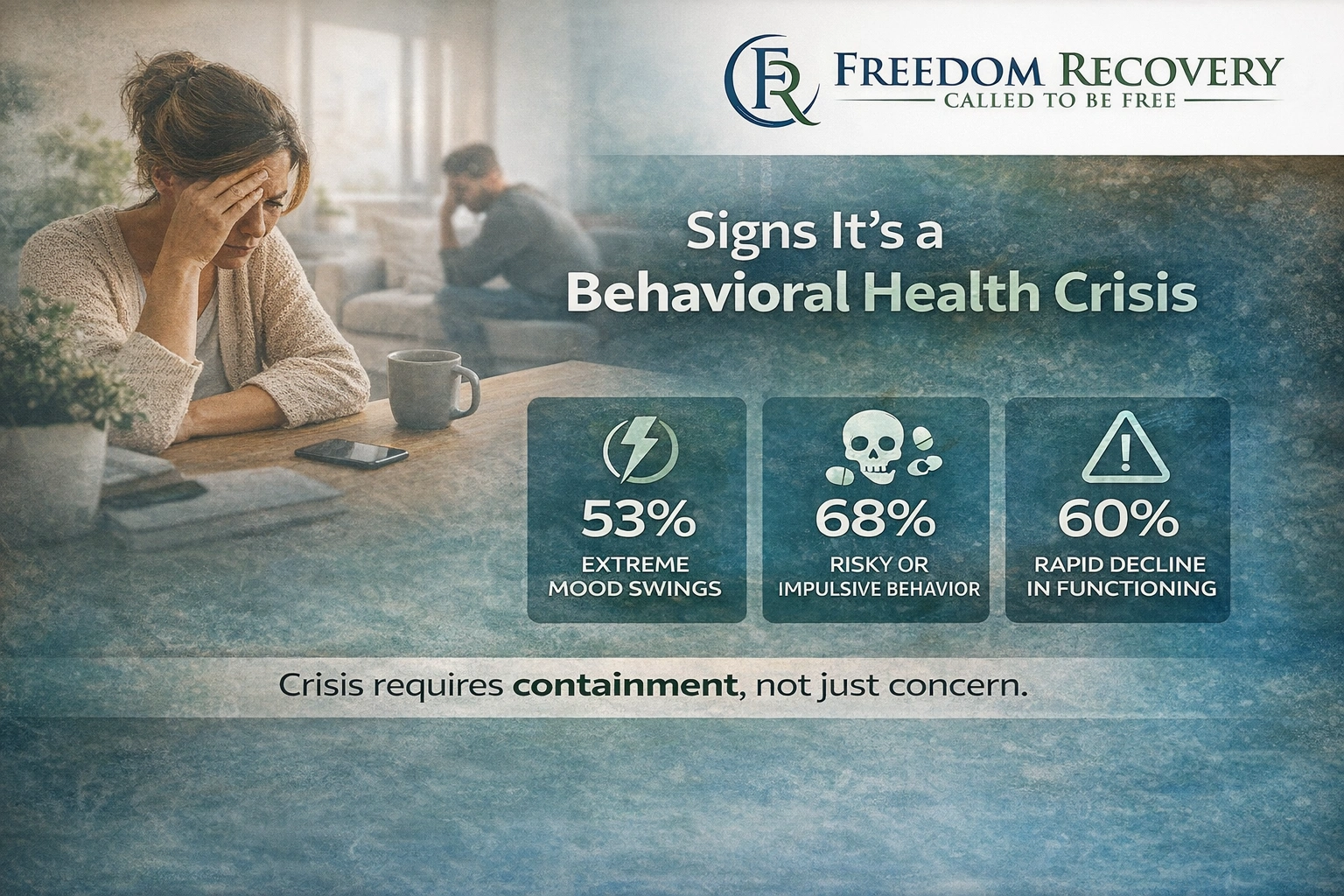
But because crisis requires containment.
Crisis Changes the Rules of Parenting
There’s a difference between rebellion and instability.
When mental health and substance use collide, the behavior you’re seeing may not be willful defiance. It may be neurological dysregulation.
You might notice:
- Extreme mood swings
- Risky or impulsive behavior
- Isolation or explosive anger
- Rapid decline in functioning
- Statements that scare you
At this point, reasoning alone often doesn’t work.
Crisis narrows the brain’s ability to think clearly. It shrinks perspective. It amplifies emotion.
This is why structured care matters. It creates a safe perimeter around chaos.
An addiction treatment program isn’t a punishment. It’s stabilization.
And stabilization is the first act of protection.
“What If I’m Making It Worse?”
Many parents freeze because they fear pushing their child further away.
You may worry:
- What if they resent me?
- What if this labels them forever?
- What if I escalate something that would have calmed down?
Those fears are real.
But here’s the hard truth: crisis rarely calms itself.
Without intervention, it often accelerates.
Substances can intensify mental health symptoms. Untreated depression can deepen into hopelessness. Anxiety can spiral into panic or avoidance.
Waiting can feel safer in the short term.
Intervening is safer in the long term.
Love Alone Cannot Regulate a Destabilized Brain
You love your child more than anyone else in the world.
But love cannot rebalance neurotransmitters.
It cannot detox a body.
It cannot treat trauma.
In crisis, your role has likely shifted from parent to constant monitor.
You’re tracking sleep. Checking pupils. Listening for tone shifts. Watching for warning signs.
That level of vigilance is exhausting.
Structured care allows trained professionals to step in — so you can step back into being a parent instead of a crisis manager.
For families in Hilliard, Ohio, access to compassionate treatment options in Addiction can provide that stabilizing support close to home.
Proximity doesn’t solve everything. But it can reduce logistical stress during an already overwhelming time.
Safety Is Not an Overreaction
Safety in structured care looks like:
- Consistent supervision
- Clinical oversight
- Therapeutic intervention
- Boundaries around substances
- Emotional stabilization
It means your child isn’t navigating overwhelming emotions alone at 2 a.m.
It means professionals are monitoring what you cannot.
Parents often tell us that once their child enters care, they sleep for the first time in weeks.
Not because the problem is gone.
But because someone else is helping carry it.
Crisis Is a Signal, Not a Verdict
It’s easy to internalize blame.
You replay conversations. You question your boundaries. You wonder if you missed signs.
Please hear this clearly:
Crisis does not mean you failed.
It often means untreated mental health symptoms, substance exposure, trauma, or stress reached a tipping point.
Blame does not stabilize a crisis.
Action does.
An addiction treatment program can interrupt momentum before consequences escalate further — legally, physically, or emotionally.
It is not the end of hope.
It is often the beginning of it.
The Fear of “Forcing” Help
If your young adult is over 18, the situation can feel even more complicated.
You may worry about autonomy. Consent. Backlash.
Those are important considerations.
But safety remains primary.
When someone is spiraling, clarity is compromised. Temporary resistance does not mean long-term harm.
Many young adults who initially resist care later acknowledge that intervention prevented something worse.
For families near Marysville, Ohio, access to steady care in Addiction can provide a balanced approach — structured without being confrontational.
Intervention doesn’t mean aggression.
It means containment.
What Often Changes First
When a young adult enters structured support during crisis, the earliest shifts are often physical.
Sleep stabilizes.
Appetite improves.
Substances clear.
Then emotional regulation begins to return.
Conversations become less explosive. Reflection becomes possible. Therapy addresses the roots — not just the symptoms.
Parents frequently say, “I feel like I’m getting my child back.”
That re-emergence can feel like sunlight after weeks of storm.
You Are Not Giving Up
Some parents tell us they feel like choosing structured care means surrendering.
It doesn’t.
It means recognizing that the current trajectory isn’t sustainable.
Crisis builds momentum.
Structured care slows it down.
Think of it like a brake on a steep hill. You’re not abandoning the car. You’re preventing a crash.
Sometimes slowing things down is the most loving action available.
Frequently Asked Questions
How Do I Know If This Is Truly a Crisis?
If your child’s behavior feels unpredictable, escalating, or unsafe — physically or emotionally — it warrants professional evaluation. You do not have to wait for a catastrophic event to act. Trust the shift in your gut.
What If They Refuse Help?
Engagement strategies vary depending on age and circumstances. Consulting with professionals can help you navigate the conversation safely and effectively. You are not expected to solve this alone.
Will This Traumatize Them?
When handled thoughtfully and compassionately, structured care is designed to reduce trauma — not cause it. Stabilization decreases risk and long-term harm.
How Long Will They Need Care?
Length varies depending on individual needs. The focus is safety first. Once stabilization occurs, the next steps become clearer.
Is This My Fault?
No. Crisis is rarely the result of one parenting decision. Seeking help is not failure. It is courage.
If You’re Standing in the Middle of the Storm
Right now, your nervous system may feel hijacked.
Every unanswered call spikes your heart rate. Every argument feels like the last straw.
You don’t need perfect clarity.
You need the next safe step.
An addiction treatment program is often that step — not because your child is beyond hope, but because hope requires stabilization.
And stabilization requires structure.
Call (888)643-7567 or visit our addiction treatment program in in Columbus, Ohio to learn more.