



You thought the worst was behind you.
Maybe they completed a program. Maybe there were months of stability. Maybe you allowed yourself to believe the crisis chapter had closed.
And now you’ve discovered they’re using again.
If you’ve found yourself reading about Freedom Recovery’s drug addiction treatment services late at night, trying to decide whether this is “serious enough” to act, let’s start with something clear:
Relapse at 20 is common.
Ignoring it is risky.
There are hard truths about young adults and substance use that most parents aren’t prepared for. But there is also real hope — especially when you act early.
Hard Truth #1: At 20, the Brain Is Still Under Construction
Your child looks grown.
They may legally be an adult. They may live independently. They may insist they know what they’re doing.
But neurologically, development is still underway.
Impulse control. Long-term decision-making. Emotional regulation. Risk assessment.
All of it is still maturing.
Add substances into that equation, and relapse risk increases — especially if anxiety, depression, trauma, or social pressure hasn’t been fully addressed.
This isn’t about weakness.
It’s about brain development colliding with exposure.
Drug Addiction Treatment for young adults often requires more than one attempt. That doesn’t mean it failed. It means the process is ongoing.
Hard Truth #2: Love Cannot Outmatch Untreated Addiction
You’ve tried everything.
Conversations.
Boundaries.
Financial support.
Threats.
Tears.
And still, they’re using.
Here’s the clinical reality:
You cannot regulate their nervous system for them.
You cannot detox their body at home.
You cannot treat underlying mental health conditions by loving them harder.
Addiction alters brain chemistry and stress response systems.
Home can be supportive — but it is rarely structured enough to interrupt escalating patterns.
For families in Grove City, Ohio, accessible treatment options in Addiction provide containment when home no longer feels safe or effective.
Containment is not punishment.
It is stabilization.
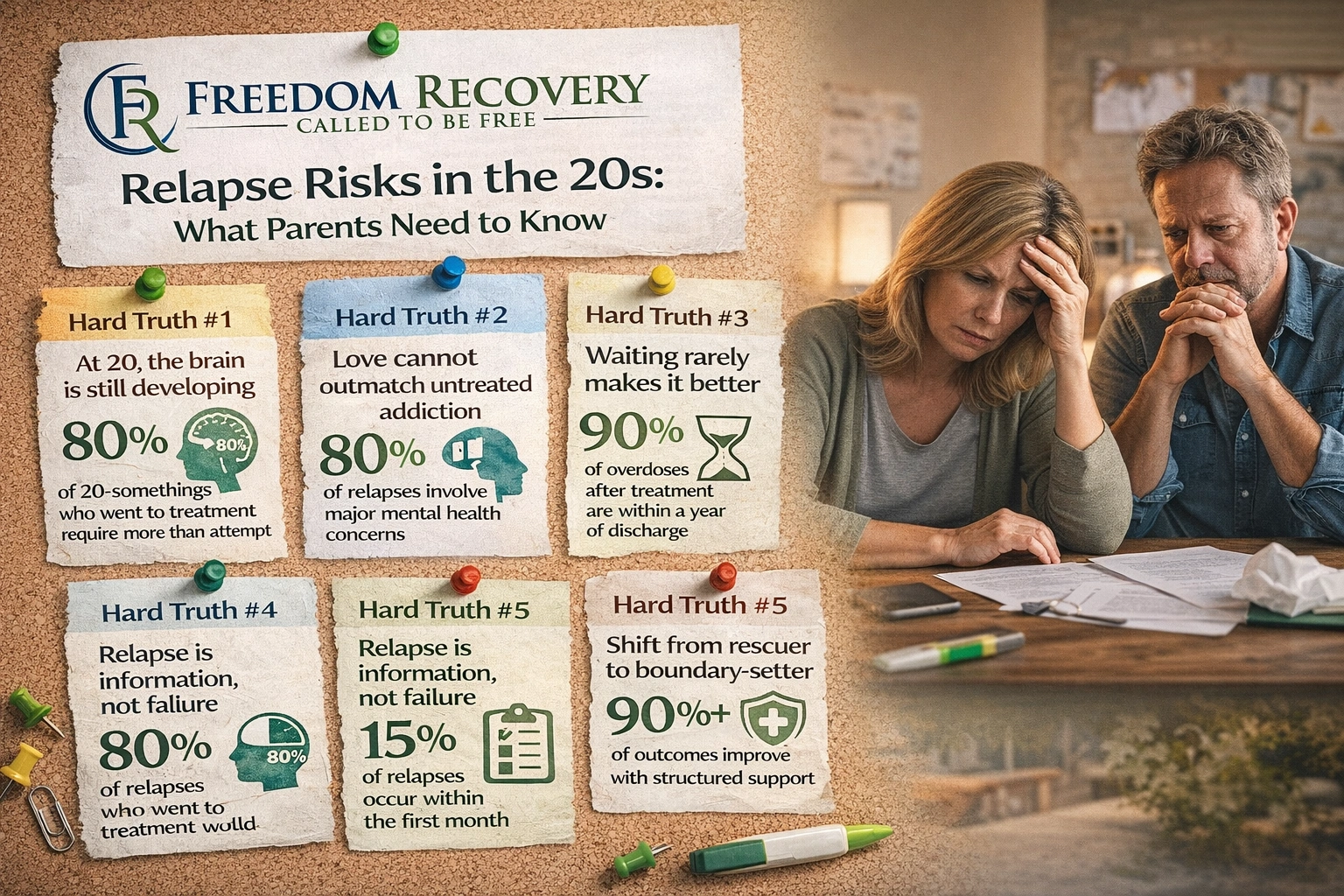
Hard Truth #3: Waiting Rarely Makes It Better
Many parents delay because they hope it’s a phase.
“College experimentation.”
“Just stress.”
“They’ll grow out of it.”
But when a 20-year-old returns to use after prior consequences, that’s a signal — not a phase.
Substance use patterns solidify quickly at this age.
The earlier structured support re-enters the picture, the more intact their future often remains.
Waiting can feel compassionate.
In active addiction, waiting often equals escalation.
Hard Truth #4: Relapse Is Information — Not Failure
It’s easy to see relapse as proof that nothing worked.
But clinically, relapse provides data:
- Was treatment long enough?
- Were mental health issues fully addressed?
- Did they return to the same peer environment?
- Were family boundaries consistent?
Drug Addiction Treatment isn’t a one-time vaccine.
It’s often part of a longer arc of stabilization and growth.
Re-engagement increases the odds of long-term recovery significantly.
Hard Truth #5: You May Need to Shift From Rescuer to Boundary-Setter
This is one of the most painful shifts for parents.
When your child is struggling, your instinct is to protect.
But rescuing can unintentionally soften consequences that motivate change.
That might mean:
- Not covering legal fees
- Not replacing lost money
- Not allowing substance use in the home
- Requiring structured care as a condition for continued support
Boundaries are not abandonment.
They are structure.
For families near Hilliard, Ohio, compassionate care in Addiction allows young adults to stabilize while parents reclaim healthy roles.
You are not meant to carry this alone.
Hard Truth #6: Young Adults Need Structure, Not Shame
Shame shuts down insight.
Structure builds it.
Young adults respond best to:
- Consistent routine
- Clear expectations
- Clinical oversight
- Peer accountability
- Family involvement with defined roles
Lectures don’t treat addiction.
Shame doesn’t restore regulation.
Scaffolding does.
Think of your child like a building still under construction. When a storm hits, you don’t blame the structure.
You reinforce it.
Hard Truth #7: You Cannot Control the Outcome — But You Can Influence It
This is the one that keeps parents awake at night.
You cannot force sobriety.
You cannot guarantee results.
You cannot prevent every future mistake.
But you can:
- Act early
- Choose structured support
- Maintain boundaries
- Stay emotionally present without absorbing chaos
- Refuse to enable continued use
Influence matters.
Consistency matters.
Timing matters.
What Actually Improves Outcomes
When young adults re-enter structured care early, outcomes improve because:
- Use is interrupted before escalation
- Mental health symptoms are stabilized
- Peer exposure shifts
- Family dynamics reset
- Risk behaviors decrease
Drug Addiction Treatment at this stage is not about “fixing” your child.
It’s about slowing the trajectory.
Slowing things down prevents catastrophic acceleration.
Frequently Asked Questions
Is Relapse After Treatment a Sign It Didn’t Work?
No. Relapse often indicates that additional support or longer engagement is needed. It provides feedback about what adjustments are necessary.
Should We Wait to See If It Stops on Its Own?
Escalation is common without intervention. Early re-engagement reduces the likelihood of legal trouble, overdose, or academic and occupational loss. Waiting increases risk.
What If They’re Over 18 and Refuse Help?
Approach matters. Consulting with professionals can help you structure conversations that increase cooperation while maintaining boundaries. Autonomy doesn’t eliminate risk.
How Do We Avoid Enabling?
Maintain consistent consequences. Avoid financial rescue. Require accountability. Support treatment, not continued use. Boundaries are protective, not punitive.
Is This Our Fault?
Addiction develops through a combination of genetic, neurological, environmental, and psychological factors. Blame does not create recovery. Action does.
If You’re Lying Awake Right Now
You might feel fear, anger, grief, and guilt in waves.
You might question every parenting decision you’ve ever made.
You might wonder if you’re about to lose them.
You are not alone in that fear.
And you are not powerless.
Drug Addiction Treatment is not an admission that you failed.
It’s an acknowledgment that your child needs more structure than home can provide right now.
Intervening is not betrayal. It’s protection.
Call (888)643-7567 to learn more about our Drug Addiction Treatment in Columbus, Ohio.