



You might still be holding the word in your chest.
Addiction.
Maybe it came from a provider. Maybe from a therapist. Maybe from a moment alone when you couldn’t avoid it anymore. However it arrived, it likely didn’t feel empowering. It probably felt heavy. Final. Frightening.
If you’re newly diagnosed, the fear isn’t dramatic. It’s intimate. It’s the quiet voice asking, What happens to me now?
If you’ve been exploring care at Freedom Recovery, you may have already looked through our addiction treatment program options. But before you commit, it’s important to understand what actually happens emotionally when fear meets real support.
Because treatment isn’t just logistics. It’s human.
The Fear Is Usually About Identity, Not Just Substances
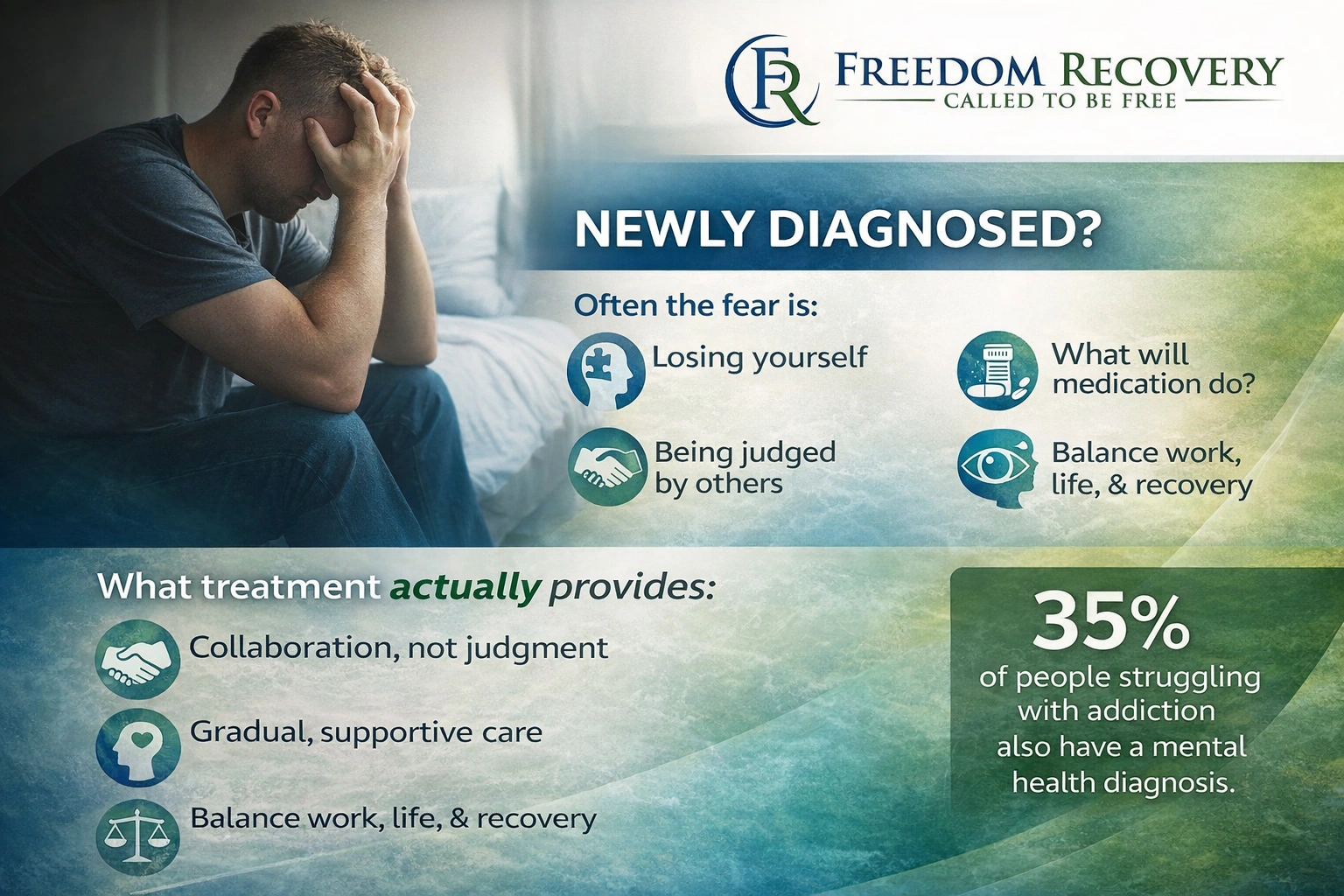
When someone is newly diagnosed, the biggest fear often isn’t stopping substances.
It’s losing themselves.
You might be wondering:
- Will I feel numb?
- Will medication change my personality?
- Will I become “the addict” in everyone’s eyes?
- What if I don’t recognize myself anymore?
These questions don’t make you resistant. They make you thoughtful.
When mental health and substance use overlap, identity can already feel shaky. The idea of stepping into structured care can feel like surrendering control.
Inside supportive treatment, the goal isn’t to strip you down. It’s to stabilize you enough to rebuild safely.
Support doesn’t replace you.
It helps you return to yourself.
The First Step Is Often Quieter Than You Expect
Many people imagine intensity right away — assessments, decisions, pressure.
What most actually experience is conversation.
A chair. A calm voice. Questions that sound like, “What’s been weighing on you?” instead of “What’s wrong with you?”
Fear is allowed in the room.
No one expects you to be certain. No one expects you to feel confident. Especially when medication is part of the conversation.
If medication is recommended, it’s discussed slowly. Questions are encouraged. Concerns are addressed directly. You are not rushed into compliance.
You are invited into collaboration.
That difference matters more than you think.
You Don’t Have to Be Brave to Begin
This may surprise you, but most newly diagnosed people don’t feel brave when they enter care.
They feel:
- Unsure
- Ashamed
- Defensive
- Overwhelmed
That doesn’t disqualify you. It qualifies you.
Support starts where you are, not where you think you should be.
Some people begin with structured daytime care for added stability. Others participate in multi-day weekly treatment while staying connected to home and work. Some need more intensive containment at first.
There is no single entry point.
Only the next right step.
For individuals living in Grove City, Ohio, having accessible, compassionate care nearby can make that first step feel less intimidating. Familiar roads. Short drives. The knowledge that you don’t have to disappear from your life to receive help.
Proximity lowers resistance.
Medication Conversations Should Feel Safe
If you were recently diagnosed, medication might already be part of the discussion.
And that can be one of the scariest pieces.
You might be thinking:
- What if it changes my personality?
- What if I feel dull?
- What if I become dependent?
- What if people judge me?
These fears deserve respect.
Inside an addiction treatment program, medication decisions are collaborative. Providers monitor closely. Adjustments happen gradually. Side effects are discussed openly.
Nothing is forced.
The goal is stabilization — not sedation.
Stability reduces chaos. It doesn’t erase character.
When symptoms are regulated, your real personality often becomes clearer, not flatter.
What Support Actually Feels Like Day to Day
Support isn’t dramatic. It’s consistent.
It looks like:
- A therapist remembering what you shared last week
- A group member nodding because they understand
- A provider asking how you actually felt on a new dose
- A schedule that brings rhythm to your days
When fear is loud, structure becomes soothing.
Early in treatment, your nervous system might feel on edge. Racing thoughts. Tight chest. Restless sleep.
Consistency regulates that.
When your body feels safer, your mind follows.
For individuals in Hilliard, Ohio, knowing that steady, compassionate care is available nearby can make that first appointment feel less like a leap and more like a step.
Safety doesn’t eliminate fear immediately.
It reduces its volume.
Fear and Support Can Exist at the Same Time
One of the most comforting realizations for newly diagnosed clients is this:
You don’t have to get rid of fear to receive support.
Fear can sit in the room with you.
You might still wake up anxious. You might still question decisions. You might still feel uncertain about medication or long-term plans.
That’s normal.
Healing inside an addiction treatment program is rarely dramatic. It’s incremental.
It might look like:
- Sleeping through the night for the first time in months
- Making eye contact during group
- Saying, “I’m scared,” instead of pretending you’re fine
- Taking medication for a week and reassessing thoughtfully
Progress often feels subtle before it feels strong.
Imagine tuning a radio that’s been full of static. At first, you just hear less noise. Then, slowly, you start hearing music.
The Shift Most People Don’t Expect
There’s a quiet turning point that happens in care.
It’s not fireworks. It’s not a breakthrough speech.
It’s smaller.
One day you notice you didn’t dread walking in.
One week you realize your thoughts aren’t spiraling as intensely.
One month you recognize you’re responding instead of reacting.
Support meeting fear consistently creates trust.
Not blind trust. Earned trust.
Trust that your voice matters.
Trust that decisions are collaborative.
Trust that your diagnosis is information — not identity.
And when trust grows, hope becomes realistic instead of abstract.
Frequently Asked Questions
What If I’m Not Sure I Agree With the Diagnosis?
That’s okay. Diagnosis is a clinical framework, not a life sentence. If you have questions or doubts, bring them forward. Clarifying your understanding is part of the process. Treatment should feel collaborative, not imposed.
Will I Be Pushed Into Medication Immediately?
No. Medication discussions are gradual and based on your unique needs. You will have space to ask questions, express hesitation, and understand benefits and risks. Informed consent is central.
How Long Does Treatment Usually Last?
Length varies depending on individual circumstances. Some people benefit from several weeks of structured care, while others continue longer. The focus is on stabilization and sustainability, not speed.
What If I’m Afraid of Being Judged?
Fear of judgment is common, especially when newly diagnosed. Inside supportive care, the environment is built around respect and confidentiality. You are not reduced to a label. You are treated as a whole person navigating a complex challenge.
Can I Still Work or See My Family?
Yes, depending on the level of care recommended. Many individuals participate in structured treatment while remaining connected to work, school, or family life. Your plan is tailored to balance stability and real-world responsibilities.
What If I Start and Feel Overwhelmed?
Overwhelm is addressed, not ignored. You can talk openly about what feels like too much. Adjustments can be made. Treatment is not a rigid script; it’s a responsive process.
If You’re Standing at the Edge of a Decision
If you’re newly diagnosed and hovering in uncertainty, you don’t need to eliminate your fear before taking a step.
Bring it with you.
Say what scares you. Ask about medication. Question timelines. Express doubt.
That honesty isn’t resistance.
It’s the beginning of partnership.
Inside an addiction treatment program, the goal isn’t to reshape you into someone else. It’s to reduce the chaos enough for you to think clearly, sleep deeply, and reconnect with the parts of yourself that feel steady.
You are not weak for being afraid.
You are human.
Fear and support can exist in the same space.
And when they do, something powerful begins: you realize you don’t have to fight alone.
Call (888)643-7567 or visit our addiction treatment program in in Columbus, Ohio to learn more.