



I didn’t wreck my car.
I didn’t overdose.
I didn’t lose my job.
I didn’t even get caught.
But I was unraveling in slow motion.
People still saw me as “doing well.” I paid my bills, held down my job, smiled at work. I checked the boxes. But inside? I was cracked, brittle, and two drinks away from falling apart most days. And that was on a “good” week.
This is the part no one tells you about: You can look fine and still be drowning. You can be high-functioning and still deeply addicted. And you can qualify for outpatient treatment—even if you haven’t hit rock bottom.
Especially if you haven’t hit rock bottom.
I Was Afraid of Losing the Life I Was Pretending to Hold Together
For months, I kept my habits private. No DUIs. No missed meetings. No slurred words in public.
But I couldn’t keep a single promise to myself:
- “Just two drinks tonight.”
- “I won’t use during the week.”
- “If I can get through this month, I’ll stop.”
It was like watching someone else drive my life while I sat quietly in the passenger seat, trying to act normal.
What stopped me from reaching out sooner? Shame, sure. But also this idea that I didn’t deserve treatment until things got worse. Like if I wasn’t falling down, I hadn’t earned the right to ask for help.
The Lie That Almost Kept Me Sick: “I Can Afford It—So I Shouldn’t Use Medicaid”
When someone mentioned Freedom Recovery’s outpatient program and said Medicaid would cover it, I shrugged it off.
I told myself, “That’s for people who need more help than me.” Which was code for: “I’m still trying to fake control.”
The truth? I needed that coverage. I needed the permission to stop spending energy pretending I didn’t need support.
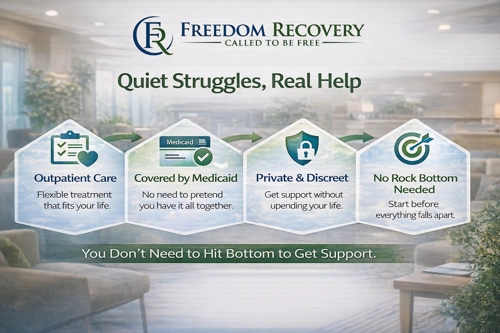
Medicaid didn’t just make it affordable—it made it possible. Financial relief removed one more excuse to delay the help I knew I needed.
Outpatient Treatment Didn’t “Fix” Me—It Let Me Be Honest
I pictured rehab like a dramatic detox scene in a movie. Cold sweats, group hugs, someone yelling about trauma. That wasn’t my story.
Outpatient treatment looked more like this:
- A quiet office where I could finally exhale.
- A therapist who asked about my pressure, not just my substance.
- Group sessions where people didn’t care how many zeros were in your paycheck—they cared that you showed up.
It wasn’t always easy. But for the first time in years, I told the truth out loud. That truth didn’t ruin my life—it rebuilt it.
I Didn’t Need a Crisis—I Needed a Container
Let me say this clearly: You do not have to fall apart to deserve care.
Outpatient treatment gave me something more useful than a crisis. It gave me a container. A structure. A schedule where I could unpack what I’d stuffed down.
I still went to work. Still cared for my responsibilities. But in those hours each week, I was real. And being real felt like a full-body exhale after years of emotional apnea.
If you’re looking for outpatient treatment in Columbus, Ohio, this is the place that didn’t wait for me to fail before it welcomed me.
No One Knew I Was There—And That Was the Point
Privacy mattered to me. So did flexibility. I couldn’t risk missing full days of work or running into someone I knew.
Freedom Recovery got that. They didn’t push for inpatient. They didn’t dramatize my condition. They listened. They offered support that met me where I was: in the tension of not-quite-breaking, but not-really-living.
And in case you’re wondering:
Yes, you can access care through Medicaid without announcing it to your employer, your family, or your social circle. You don’t have to make a scene to start healing.
Progress Looked Like Getting Bored of the Chaos
Early on, my therapist said something that stuck: “You don’t need to fall. You can step off the path.”
That’s what outpatient treatment gave me. A quiet place to step off the path of self-destruction and into something steadier.
I didn’t wake up cured. But I woke up clearer.
The need to use started to dull. The shame softened. I got bored of chaos. Peace started to feel more interesting than numbing out.
That’s recovery too.
FAQs: What I Learned About Getting Help While “Still Holding It Together”
Do I have to admit I’m an addict to start?
No. I didn’t. I just had to admit that something wasn’t working anymore. Treatment met me where I was—curious, scared, and unsure. Labels came later, if at all.
Is outpatient treatment covered by Medicaid?
Yes, fully in my case. That included therapy, group, and support services. Freedom Recovery handled the approvals—I just had to show up.
Can I still work while getting treatment?
Absolutely. I did. That’s what outpatient means—you don’t step away from life, you learn how to live it differently. They worked with my schedule, not against it.
What if I start and ghost again?
Then you try again. That’s not failure. That’s part of it. The team at Freedom Recovery doesn’t shame you for ghosting—they welcome you back when you’re ready.
Will people know I’m in treatment?
Only if you tell them. It’s confidential. My job didn’t know. My family didn’t know until I was ready to share. I didn’t have to blow up my life to start building it back.
I’m Still “Functioning.” But Now I’m Actually Living.
Here’s the thing: I still work. I still show up for my responsibilities. But now I do it without the numb autopilot.
Recovery didn’t take away my strength—it gave it direction.
Outpatient treatment didn’t rescue me from disaster. It rescued me from the slow erosion of joy, of clarity, of self-trust.
I didn’t need a bottom. I needed a beginning.
And that began when I walked into Freedom Recovery and finally said: “I’m ready to stop lying to myself.”
Need a fresh start outside Columbus?
If you’re looking for outpatient treatment in Dayton, Ohio or Galion, Freedom Recovery offers Medicaid-supported programs across Ohio. Support that fits your life—not one that flips it upside down.
If You’re Reading This, You’re Close Enough to Start
You don’t need to hit bottom. You don’t need permission.
You just need a pause. A breath. A moment of honesty.
If that’s where you are, then yes—outpatient treatment can work for you.
I know. I’ve lived it.
Ready for your next step?
Call (888) 643-7567 to learn more about our outpatient treatment services in Columbus, Ohio.
The help is real. The cost is covered. And you don’t have to fall apart to begin again.